In 2026, the concept of a "one-size-fits-all" event has become a relic of the past. For decades, the industry operated on the principle of the "Average Attendee"—a hypothetical person who represented the middle ground of an entire audience. Today, leading event production agencies have abandoned this mid-point in favor of the "Segment of One." Driven by mature Agentic AI and high-velocity data integration, events are no longer linear broadcasts; they are dynamic, living ecosystems that rearrange themselves around the unique professional goals, behavioral patterns, and personal preferences of every individual in the room. This shift represents the most significant leap in hospitality and corporate engagement since the invention of the digital event app.
The Death of Static Agendas
The printed PDF agenda and the static mobile schedule are officially dead. High-growth organizations now utilize AI-Powered Dynamic Scheduling, a system where the "Run of Show" is different for every guest. When an attendee registers, the AI analyzes their CRM profile, recent digital activity, and stated learning objectives to construct a Curated Journey. If an attendee is a CTO focused on sustainable supply chains, their "Recommended Path" won't just list relevant sessions; it will prioritize workshops where their specific industry peers are also present.
Furthermore, these agendas are "Living Documents." If a particular breakout session starts trending or reaches 90% capacity, the AI instantly pushes a "High-Match" alternative to the guest's device. This might include a 1-on-1 demo with a lead speaker or an invitation to an exclusive digital "Overflow Lounge" where they can interact with the content via spatial audio. This eliminates the "FOMO" (Fear of Missing Out) that once plagued large-scale conferences, ensuring that every minute of the guest's time is spent on high-value interactions. By 2026, the success of an event is no longer measured by the total number of attendees, but by the "Content Relevance Score" assigned to each individual journey.
Precision Networking via Matchmaking
Networking has historically been the primary driver for event attendance, yet it was often left to chance—what we call "Professional Roulette." In 2026, Intelligent Matchmaking has turned connection into a science. Using Agentic AI, the event platform acts as a proactive broker rather than a passive directory. These systems do not just match people based on job titles; they analyze "Compatibility Scores" derived from shared professional challenges, complementary skill sets, and even past interaction data.
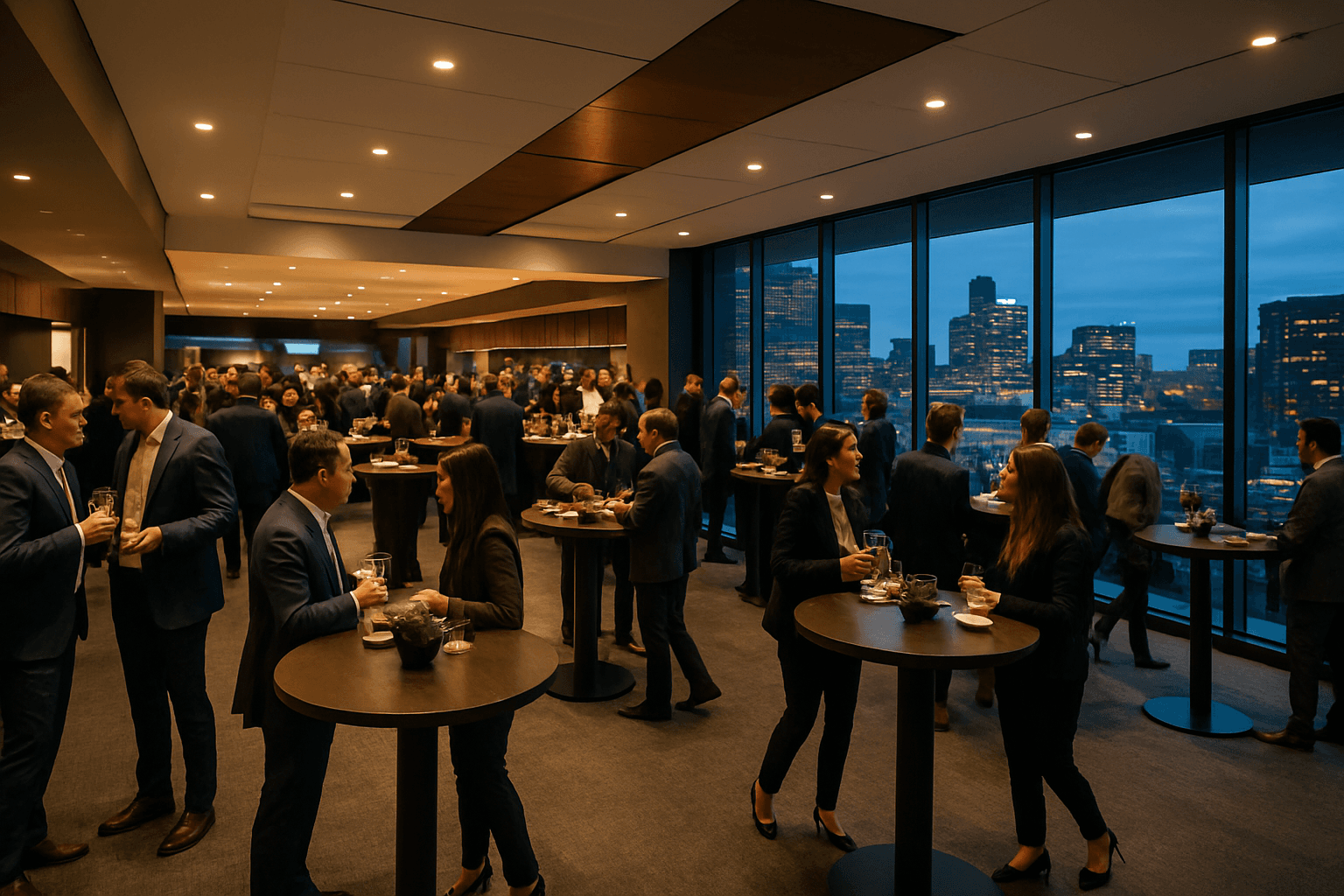
Imagine entering a "Smart Lounge" where your wearable device or smartphone subtly notifies you that you are within six feet of a high-value collaborator identified by the AI. By removing the friction of the "cold approach," agencies are delivering the one thing attendees value most: curated human connection. According to 2026 industry benchmarks, AI-assisted matchmaking has led to a 44% increase in meaningful B2B meetings compared to traditional "mix and mingle" formats. This precision ensures that an attendee doesn't just leave with a stack of business cards, but with a handful of strategic partnerships that have already been vetted for synergy.
Industry Insight 2026: Agencies that utilize "Biometric Networking"—using opt-in heart rate and engagement signals to identify "High-Energy" conversation zones—are seeing a 30% higher re-booking rate for corporate summits.
The Rise of AI Digital Concierges
The 2026 "Help Desk" has been replaced by the AI Digital Concierge. These are not the primitive, rule-based chatbots of the early 2020s. These are sophisticated agents with full "Event Context Awareness" and multi-modal capabilities. Through spatial audio or text, the Concierge guides the attendee through the physical and digital venue. If the AI detects that an attendee has been in the "Exhibition Zone" for two hours without a break, it might suggest a nearby "Quiet Zone" or offer a personalized culinary recommendation based on the guest’s dietary profile and the real-time availability of the catering stations.
More importantly, the Concierge handles On-the-Fly Logistics. If a keynote session runs late, the AI agent automatically communicates with the other parties in an attendee’s schedule to reschedule 1-on-1 meetings, update calendar invites, and even notify transport services. This "Frictionless Flow" allows attendees to remain in a "Deep Learning" state, focused entirely on the content and their peers, rather than being bogged down by the administrative friction of navigating a complex event.
AI Cloud Photography and Real-Time Social Impact
Speed is the primary currency of 2026. Traditional event photography, where a gallery is emailed to guests three days after the closing ceremony, is obsolete. Modern event services now feature AI Cloud Photography with Facial Recognition. As professional photographers (and automated roaming cameras) capture the event, AI algorithms perform instant color grading and lighting correction in the cloud.
Within minutes, an attendee receives a push notification: "Your professional photos are ready." By simply taking a "verification selfie," the system instantly pulls every high-resolution photo they appeared in and provides them with brand-optimized, "social-ready" crops. This has resulted in a 70% increase in social media sharing during the event itself. For the brand, this means millions of organic impressions are generated while the event is still trending, turning every guest into a high-fidelity brand ambassador in real-time.
Measuring Real-Time Sentiment and ROE
The most profound impact of AI-driven personalization is the ability to measure Real-Time Sentiment Analysis. In 2026, we no longer rely on the "Post-Event Survey," which historically suffered from low response rates and "Recency Bias." Instead, event production companies use anonymized computer vision and "Engagement Heatmaps" to track the crowd's energy levels.
By analyzing micro-signals—such as dwell time at specific activations or the "posture of attention" during a keynote—the coordination team can make Agile Adjustments. If the data indicates that guest energy is dipping in a specific hall, the AI can automatically trigger a shift in environmental factors: adjusting the music tempo, shifting the lighting temperature to a more "alert" spectrum, or alerting a speaker to conclude their session earlier. This data is synthesized into a comprehensive ROE (Return on Experience) Report, giving stakeholders a second-by-second breakdown of how their investment moved the needle on audience sentiment.
Conclusion: The Human Element in an AI World
While the technology of 2026 is breathtaking, the goal of hyper-personalization is paradoxically to make events feel more human, not less. By removing the "clutter" of irrelevant content and the "noise" of bad networking, AI clears the path for authentic, high-value interactions. For a brand, the "Segment of One" isn't just a technical achievement; it is the ultimate expression of respect for their audience’s time and attention.
In the future of event production, the most successful agencies won't be those with the biggest screens, but those with the smartest algorithms—those who can take a crowd of 5,000 and make every single person feel like the event was built exclusively for them. Excellence in 2026 is defined by the ability to disappear into the background, leaving the guest with a perfectly curated experience that feels like magic.