About Us
Weddings
Corporate Events
Private Parties
Non-Profit & Government
Celebrity & VIP
City Guide
Blog
Contact
  • About Us
  • Weddings
  • Corporate Events
  • Private Parties
  • Non-Profit & Government
  • Celebrity & VIP
  • City Guide
  • Blog

Company

  • About Us
  • Showcases
  • Blog
  • FAQs
  • Contact Us

Event Types

  • Weddings
  • Corporate Events
  • Private Parties
  • Non-Profit & Government
  • Celebrity & VIP

Service Areas

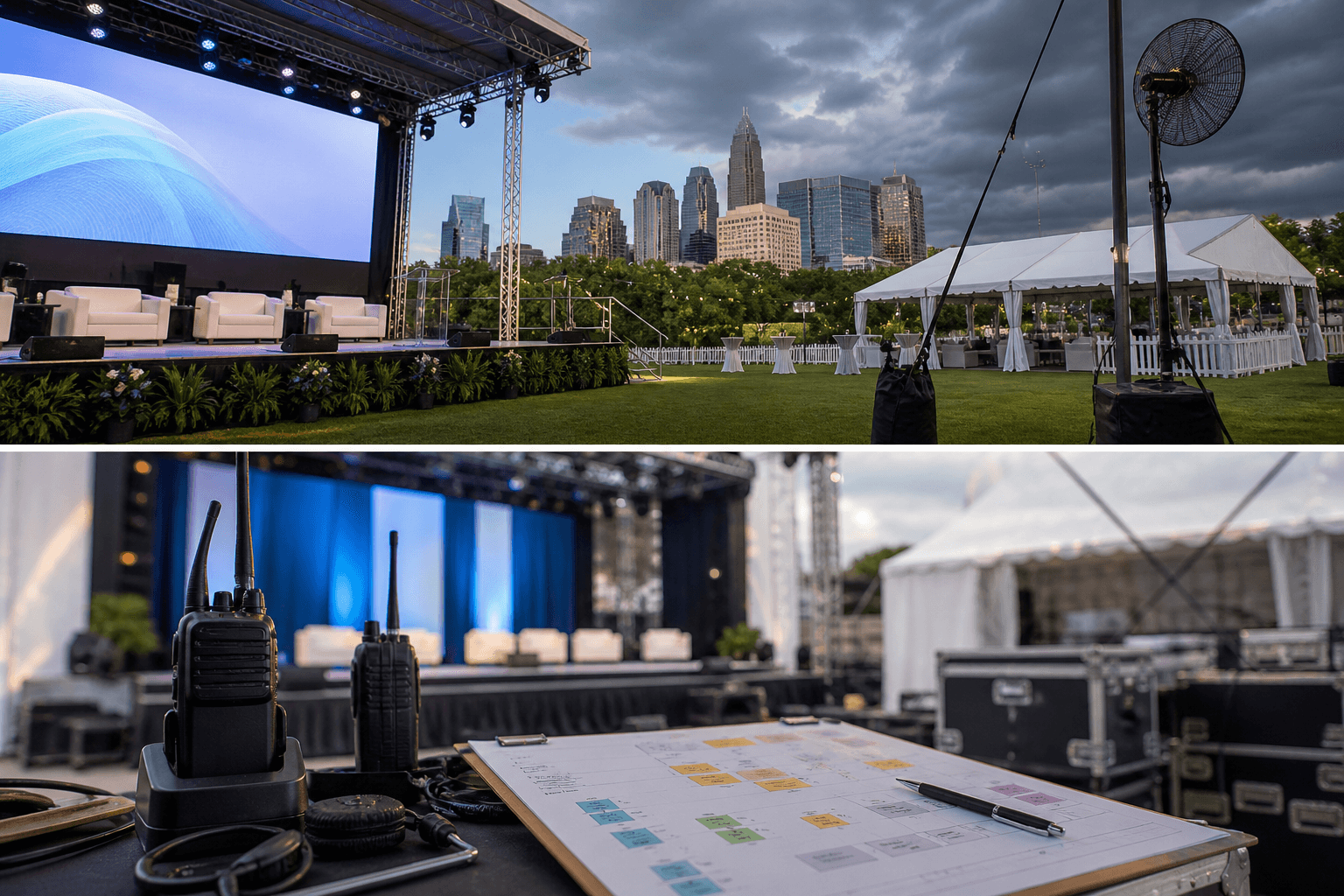
Outdoor event weather planning setup in Charlotte with tenting, signage, and contingency equipment

Charlotte Outdoor Event Weather Planning

12/11/20265 min

A Charlotte-specific framework for managing heat, rain, power, tenting, communication, and decision deadlines for outdoor private events.
Back

Latest Event Planning Ideas

Crafting Unforgettable Events in the Heart of Los Angeles

Dec 29, 2023

Crafting Unforgettable Events in the Heart of Los Angeles

Essential Tips for Successful Event Planning in LA

Dec 29, 2023

Essential Tips for Successful Event Planning in LA

Inclusive Event Planning in Los Angeles' Melting Pot

Dec 29, 2023

Inclusive Event Planning in Los Angeles' Melting Pot

Read all

Summary

  • What should Charlotte hosts decide before weather becomes a problem?
  • How hot is too hot for an outdoor Charlotte event?
  • When does rain become a switch-from-plan-A-to-plan-B event?
  • How should tents, power, and flooring be specified for Charlotte conditions?
  • What communication plan keeps guests calm if the forecast changes?
  • Which vendors need weather-specific instructions before event day?
Charlotte Outdoor Event Weather Planning article image

A Charlotte-specific framework for managing heat, rain, power, tenting, communication, and decision deadlines for outdoor private events.

What should Charlotte hosts decide before weather becomes a problem?

For Charlotte outdoor private events, the core decision is not whether weather might change—it is when you will stop waiting and switch to a backup. Build the plan around three triggers: comfort, safety, and execution. In Charlotte, late spring through early fall can bring high heat, sudden storms, and humidity that affects guest comfort well before rain starts. Set a primary forecast review at 7 days out, a readiness review at 72 hours, and a final go/no-go decision at 24 hours. At each checkpoint, confirm the same items: guest count, shade coverage, tent availability, power needs, and whether the backup site can be staffed on short notice. The most useful weather plan is one that specifies who decides, what data they use, and what happens immediately after the decision.

How hot is too hot for an outdoor Charlotte event?

Heat in Charlotte is often the first operational risk, especially for private events with formalwear, children, older guests, or alcohol service. A practical threshold is the heat index, not just the air temperature. If the forecast heat index reaches 90°F or above, plan for shade, water, and short exposure times. At 95°F and above, move service timelines earlier in the day, increase cooling capacity, and reduce standing-room segments such as cocktails or welcome lines. If you expect 100°F or higher, treat an uncovered plan as high risk unless the event is brief and guests can rotate indoors or into air-conditioned relief. Concrete mitigations include fans that actually move air, misting only where flooring and décor can handle moisture, cold beverage stations at entry points, and seating plans that avoid direct sun during key moments. For formal events, schedule photos, ceremonies, or speeches before peak heat whenever possible.

When does rain become a switch-from-plan-A-to-plan-B event?

Charlotte rain decisions should be based on timing, duration, and surface conditions rather than a generic chance of precipitation. A 30% chance of rain is usually a watch item, not a cancellation driver. The stronger trigger is the forecast window: if rain is likely within two hours of guest arrival, protect entry, parking, and load-in first. If steady rain is expected for more than 30 to 60 minutes during guest-facing portions of the event, the backup plan should be live. The most disruptive Charlotte rain issue is often not heavy downpour alone, but wet lawns, muddy access paths, and delayed vendor load-in that can cascade into missed service windows. Prepare covered walkways, floor protection, and a dry equipment route. If the event includes a ceremony, decide in advance whether the transfer happens before guests arrive or after a defined threshold such as the first audible thunder or a radar-confirmed cell within the travel radius.

How should tents, power, and flooring be specified for Charlotte conditions?

A tent is only as useful as the support systems around it. For Charlotte outdoor events, ask whether the tent is sized for both guest count and weather behavior. Sidewalls matter if wind-driven rain is possible, but fully enclosed tents require ventilation planning in humid weather. Flooring is essential on soft ground and strongly recommended whenever you need stable walking paths, vendor equipment, or a polished guest experience after rain. Power planning should include a load list for lighting, catering equipment, cooling, audio, and décor features. Do not assume one generator can carry all demands; verify startup loads, fuel runtime, and where refueling can occur without interrupting guests. Place generators where noise, exhaust, and access are controlled. If you are using tents in a Charlotte summer, build in airflow and backup cooling, because enclosed space plus humidity can quickly become uncomfortable even without direct sun.

What communication plan keeps guests calm if the forecast changes?

Guests do not need every forecast update; they need one clear instruction at the right time. Draft a communication sequence that answers three questions: are we still on, what should guests bring, and what changes if weather shifts. Send a preliminary weather note 48 to 72 hours out if there is any meaningful risk, especially for dress code, footwear, parking, or umbrella guidance. On the day of the event, use one spokesperson and one channel for final updates so guests do not receive conflicting messages from hosts, vendors, and family members. If a move indoors is possible, state the alternate arrival point and the latest time the change may be announced. For outdoor private events in Charlotte, clarity matters more than optimism. A brief message about what is changing, where to go, and when to arrive will preserve confidence and reduce bottlenecks.

Which vendors need weather-specific instructions before event day?

Every vendor should know what weather changes their workflow, but some need explicit instructions. Catering teams need protected prep areas, generator access, and a rain-safe service path. AV teams need power redundancy and equipment cover that does not block sound or airflow. Rentals crews need confirmation on tent weights, staking permissions, flooring delivery, and whether mud or slope affects placement. Transportation teams need a parking or drop-off contingency if wet ground limits access. Photography teams need a covered backup location and a light plan if the ceremony or portraits move. The best practice is a single weather instruction sheet with contact names, arrival adjustments, site map notes, and the decision deadline for each vendor group. That prevents last-minute scrambling and helps each vendor protect both the event and their equipment.

What is the best decision deadline for a Charlotte backup plan?

The right deadline depends on what changes when you switch plans. For a fully outdoor event with tenting and minimal stage production, a 24-hour decision deadline is often workable. If you need an indoor venue, room flip, or significant AV changes, aim for 48 to 72 hours so staff, rentals, and catering can reconfigure without compression risk. If lightning is the primary concern, the final operational call may need to happen much later, but the fallback must already be ready. The key is to separate the strategic decision from the safety call: strategic decisions lock in staffing and layout; safety calls handle real-time weather during the event. In Charlotte, that distinction matters because storms can move quickly, but logistics do not reset quickly.

Need a Charlotte weather plan that holds up on event day?

If you need a structured weather decision framework for a Charlotte outdoor event, use our team to pressure-test timelines, contingencies, and guest communication before you commit. Contact Nexa Events: https://nexaevents.com/contact-us

Contact Nexa Events

Related Articles

Crafting Unforgettable Events in the Heart of Los Angeles

Dec 29, 2023

Crafting Unforgettable Events in the Heart of Los Angeles

Essential Tips for Successful Event Planning in LA

Dec 29, 2023

Essential Tips for Successful Event Planning in LA

Inclusive Event Planning in Los Angeles' Melting Pot

Dec 29, 2023

Inclusive Event Planning in Los Angeles' Melting Pot

The Power of Partnering with Full-Service Event Companies

NationwideEvent PlanningMar 12, 2026

The Power of Partnering with Full-Service Event Companies

This cornerstone piece analyzes the macro-economic shift toward integrated event solutions. It explains how a single-source events company eliminates "communication decay," optimizes massive budgets through resource circularity, and navigates the high-stakes regulatory environment of 2026. It is designed to rank for broad, high-volume terms by providing deep-dive insights into the "Single Point of Truth" management model.

FAQ

Use a combination of heat index, rainfall timing, and site conditions. Heat index at 90°F is a comfort alert, 95°F is a serious mitigation point, and 100°F is often a strong reason to add or move shelter. For rain, the stronger trigger is likely impact during arrival, service, or guest movement rather than a small percentage chance.

For most private events, 24 hours is a practical final call window. If the event requires a full indoor swap, major rental changes, or room flips, 48 to 72 hours is safer. Keep lightning and severe weather as real-time safety exceptions.

Not always, but they do need a defined backup. That may be a tent, an indoor room, a covered terrace, or a rescheduled timeline. The right choice depends on guest count, season, service style, and how much weather risk you can tolerate.

Include the decision owner, the update timeline, the guest message, the alternate arrival point, parking changes, and the latest time guests can be notified. Keep the message short and practical so guests know what to do without reading multiple updates.

Humidity and wet ground are often overlooked. Even without severe rain, humid conditions can make tents uncomfortable, affect sound, and create muddy access paths that slow vendors and guests.

The Power of Partnering with Full-Service Event Companies

NationwideEvent PlanningMar 12, 2026

The Power of Partnering with Full-Service Event Companies

This cornerstone piece analyzes the macro-economic shift toward integrated event solutions. It explains how a single-source events company eliminates "communication decay," optimizes massive budgets through resource circularity, and navigates the high-stakes regulatory environment of 2026. It is designed to rank for broad, high-volume terms by providing deep-dive insights into the "Single Point of Truth" management model.

How to Choose the Right Event Planning Company

NationwideEvent PlanningMar 31, 2026

How to Choose the Right Event Planning Company

Choosing the right event planning company is essential for organizing successful corporate events. This guide explains what event planners do, how to evaluate experience, services, communication, and budgeting practices, and what questions businesses should ask before hiring a professional planner. Understanding these key factors helps organizations reduce risk, manage costs, and create well-organized events that meet business goals.

Read all
Sponsored Ad
Crafting Unforgettable Events in the Heart of Los AngelesFeatured Event ArticleCrafting Unforgettable Events in the Heart of Los AngelesView Article

Most Read This Month

The Power of Partnering with Full-Service Event Companies

NationwideEvent PlanningMar 12, 2026

The Power of Partnering with Full-Service Event Companies

This cornerstone piece analyzes the macro-economic shift toward integrated event solutions. It explains how a single-source events company eliminates "communication decay," optimizes massive budgets through resource circularity, and navigates the high-stakes regulatory environment of 2026. It is designed to rank for broad, high-volume terms by providing deep-dive insights into the "Single Point of Truth" management model.

How to Choose the Right Event Planning Company

NationwideEvent PlanningMar 31, 2026

How to Choose the Right Event Planning Company

Choosing the right event planning company is essential for organizing successful corporate events. This guide explains what event planners do, how to evaluate experience, services, communication, and budgeting practices, and what questions businesses should ask before hiring a professional planner. Understanding these key factors helps organizations reduce risk, manage costs, and create well-organized events that meet business goals.

Renting Photo Booths for Unforgettable Events in Los Angeles

Sep 6, 2023

Renting Photo Booths for Unforgettable Events in Los Angeles

Elevate Your Event with Flower and Champagne Wall Rentals

Los AngelesEvent PlanningFeb 4, 20254 min read

Elevate Your Event with Flower and Champagne Wall Rentals

Event Agency: Services, Costs, and Benefits

NationwideEvent PlanningMar 31, 2026

Event Agency: Services, Costs, and Benefits

Read all